
Quick Summary
Rising IT demands and tighter budgets are pushing businesses to move away from CapEx-heavy hardware purchases in favour of OpEx-based device leasing. OpEx offers predictable monthly costs, improved cash flow, and greater flexibility to refresh technology and scale teams. Keep reading to learn more.
CapEx vs OpEx in IT Projects
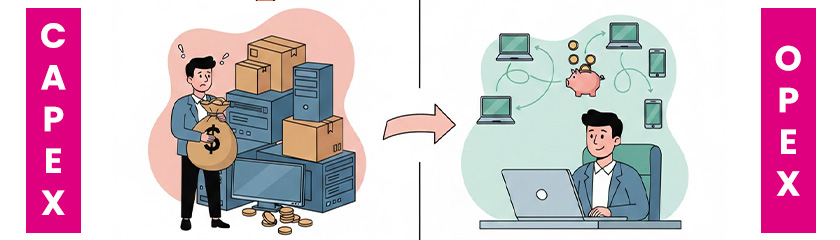
When businesses purchase devices outright, they’re operating under a CapEx model. This means paying a large upfront cost, owning the equipment, and carrying it as an asset that depreciates over several years.
It’s a traditional approach, but it ties up capital and leaves companies responsible for maintenance, support, and eventual replacement.
In contrast, OpEx models, like leasing, subscriptions, or Device as a Service (DaaS), turn hardware into a predictable operating cost instead of a one‑time investment. This gives companies access to the devices they need without the financial strain of ownership.
One simple way to think about it is:
CapEx = investment + depreciation + ownership = locking companies into the hardware they buy.
While OpEx = ongoing cost + flexibility + scalability = allows them to scale up or down as the business changes.
Modern IT environments are naturally pulling organisations toward OpEx — we cover the details in the next section.
Why More Businesses Are Switching to Device Leasing (OpEx) in 2026


Preserves Cash Flow
Many businesses are moving toward leasing because it removes the need for large upfront purchases.
Instead of locking away tens of thousands of pounds in devices, companies can spread the cost over time and keep cash available for growth, hiring, and other operational needs.
This becomes even more important as IT spending is growing, projected to exceed $6 trillion in 2026.
Predictable Monthly Costs
Leasing gives businesses a stable, predictable cost structure.
Instead of unplanned repair bills, depreciation tracking, or sudden replacement costs, OpEx models create a steady monthly payment.
Hardware Refresh Cycles Made Easy
With leasing, devices are replaced on a planned schedule rather than kept beyond their useful life.
This ensures teams have access to up-to-date, secure hardware without the disruption and cost of ad-hoc refresh projects.
Reduced Risk
Ownership transfers the risks of depreciation, obsolescence, and end-of-life disposal to the business.
Leasing shifts much of this risk to the provider, simplifying lifecycle management while supporting compliance, security, and sustainability goals.
How Leasing Reduces Total Cost of Ownership (TCO)
Example Cost Comparison
- Buying 50 laptops outright: £1,200 per device = £60,000 CapEx upfront
- Leasing the same fleet: Roughly £2,500–£3,000 per month over 36 months, which protects cash reserves and provides predictable budgeting
- Result: Less financial strain and more flexibility for growth

Lifecycle Savings
- Unused or idle devices often go unnoticed (especially in hybrid and remote teams) as a source of wasted spend.
- Leasing allows devices to be returned, replaced, or reassigned as teams change, reducing unnecessary cost.
- End-of-life collection and recycling are handled by the provider, which removes time-consuming admin and disposal costs.
Support Savings
- Repairs, replacements, and device setup are included in the monthly leasing cost.
- Businesses avoid unexpected repair bills and reduce the workload on internal IT teams.
- Faster swaps and support help keep employees productive with minimal disruption.

How HardSoft Helps Businesses Get More Value from OpEx
Low Monthly Fees & All‑Inclusive Bundles
HardSoft’s device leasing wraps everything into one clear monthly cost. Devices are supplied with setup and support included, helping businesses avoid unexpected charges and maintain full visibility over IT spend.
With leasing options starting from as little as £11.50 per week for a MacBook Pro (M5), high-performance hardware becomes accessible without large upfront investment.
Flexible Leasing Options to Suit Different Needs
HardSoft offers two leasing models depending on how much flexibility or ownership a business wants:
Flexi
- Own the device at the end for £1
- Switch devices after 12 months
- Lifetime support included
- Earn reward points
- Cancel from 12 months
Pure
- Refresh devices at the end of the term
- Switch devices after 24 months
- Lifetime support included
- Earn reward points
- Cancel from 24 months
This allows businesses to choose whether ownership or regular refresh cycles make more sense for their IT strategy.
Self-service Control Through Dave
HardSoft customers also get access to Dave, the self-service portal that makes device management simple.
Through Dave, businesses can request changes, track devices, manage users, and raise support requests, all in one place, without long email chains or delays.
Ready to reduce upfront costs and simplify device management? Get a quote from HardSoft today and see how OpEx can work harder for your business.


Steve Hill has been a cornerstone of HardSoft since 2005, bringing two decades of experience in leasing Apple devices and delivering tailored tech solutions to businesses across the UK. As HardSoft’s go-to expert in cybersecurity, Steve specialises in Sophos and Barracuda software, helping clients safeguard their operations with confidence. Steve’s passion for tech, teamwork, and trusted solutions makes him a valued voice on the HardSoft blog.
LinkedIn: Steve Hill
Email: steve@hardsoftcomputers.co.uk
Tel: 0204 566 8856